Can There Be Intellect Without Soul? The Case of Artificial Intelligence
Just like animals, AI doesn’t have a soul. But while animals have a brain, AI has something similar, a processor chip. It can do many impressive things, but there are also important things it simply can’t do, because it doesn’t have a soul. But firstAI has no soul, but it has a powerful logical capacity and so It can perform logical, reasoning, and imagination-like tasks, but it’s essentially a powerful calculator, able to work with numbers, variables, and shapes in areas like science, math, commerce, and engineering.
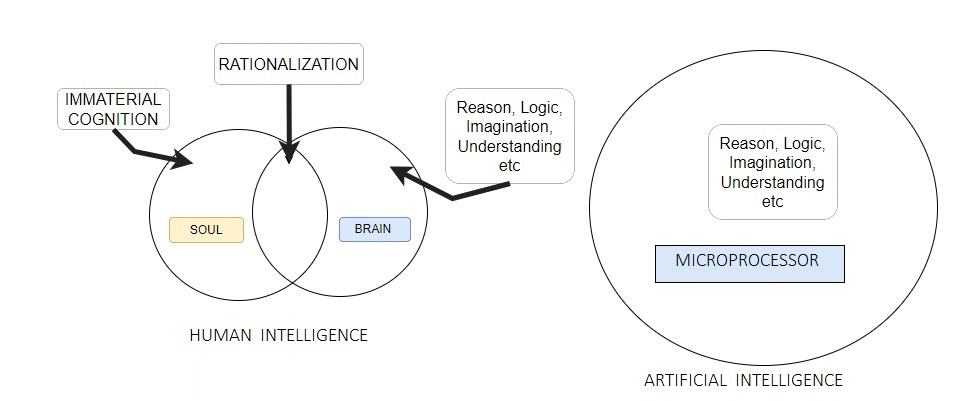
And compared to humans, A.I has a huge capacity to generate concrete-abstract notion related contents on it’s own.
But since A.I don’t have a soul, they can’t acquire or grasp fundamental abstract concepts such as “1” , “point” or “gravity” . Nor can they generate comprehensive abstract concepts.
But wait,
Can’t AI work with fundamental and comprehensive abstract concepts too?”
And yes, it can, but only from a logical and computational perspective. It can simulate rationalization by rearranging existing comprehensive abstract data, such as scientific laws, mathematical formulas, software code, or even generate layered conceptual themes for stories, in a logically valid and often sophisticated manner. However, AI is not creating new comprehensive abstract concepts, laws, or theories, nor is it producing truly original stories with novel ideas. It operates entirely within the domain of logic, reordering what already exists, not coming up with anything truly new.Humans with soul has ability of immaterial cognition and the Soul&Brain collaboration gives humans the ability of rationalization and so humans can and may develop mathematics whose fundamental abstract concept is not 1 and whose comprehensive abstract concepts is not rooted in 1, so that, this mathematics may be it will be used to unravel the mystery of quantum universe etc. A.I can’t generate a new mathematics that’s not rooted in fundamental abstract notion of 1.
Humans with soul may develop geometry whose fundamental abstract concept is not point and whose Comprehensive abstract concepts not rooted in fundamental abstract notion of point, so that, this geometry may be used to unravel the mysteries of multidimensional universe etcetera .
A.I can’t generate new geometry that’s not rooted in fundamental abstract concept of point. Right now, humans develop geometry whose fundamental abstract concept is not point, may seem highly impossible for humans. But remember, before Einstein, it was impossible to imagine the fundamental abstract notion of gravity was anything other than force. Then came Einstein, who introduced the concept of space-time. In his theory, the fundamental abstract notion of gravity was not force anymore, but the curvature of the space-time continuum.
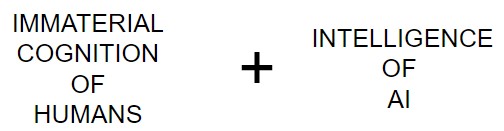
The powerful ability of AI to process concrete-abstract notions, when combined with the human capacity for conceiving fundamental abstract concepts, can significantly enhance our development of comprehensive abstract ideas.
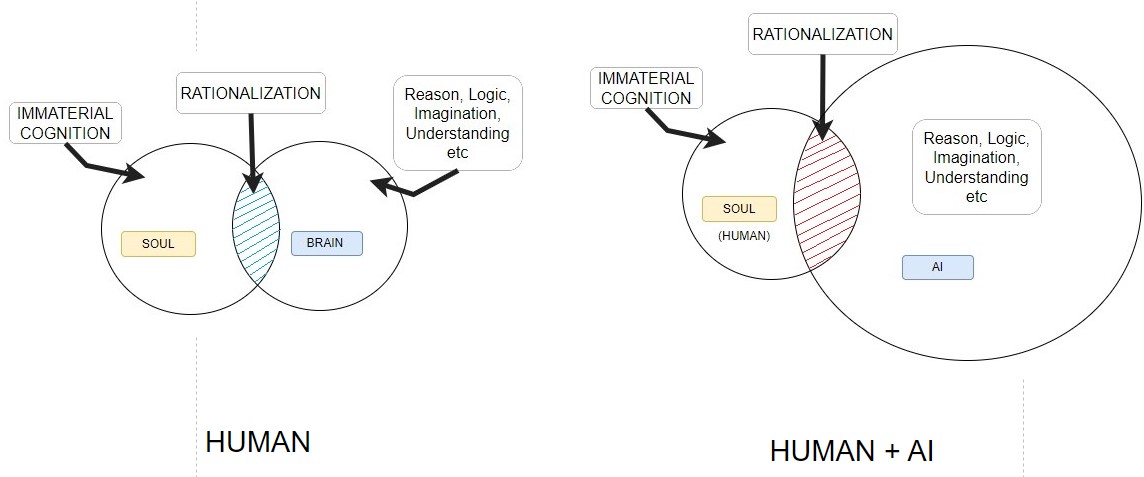
AI’s advanced logical capabilities enable it to generate increasingly complex concrete-abstract notions. This capacity can be visually represented as a much larger circle compared to the circle representing the human ability to generate such notions through logic or imagination. When we use AI, we are essentially outsourcing much of our concrete-abstract processing to it. This substitution expands our overall rationalization capacity.
Consequently, if we compare the shaded area representing human rationalization alone with the shaded area representing human-AI interaction, the latter is substantially larger. This illustrates how integrating AI amplifies our reasoning process.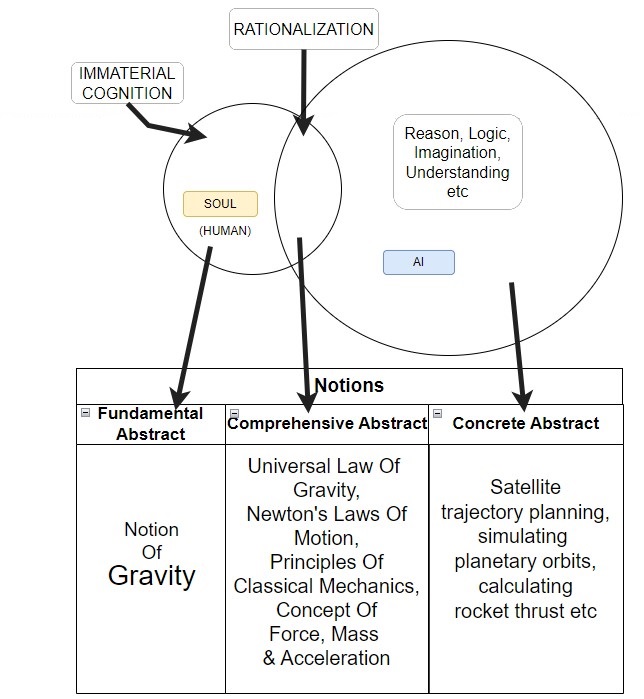
Importantly, this enhancement doesn’t replace the human mind’s ability to work with fundamental abstract concepts and comprehensive abstract to form applicable concrete abstract to real world, it complements it. By combining human intellectual insight with AI’s computational power, we can develop more complex comprehensive abstract as well as more useful concrete abstract systems than ever before.